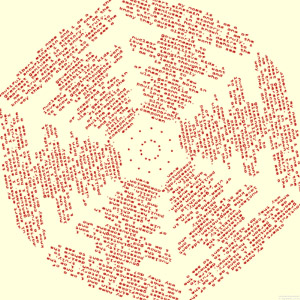
i am a beautiful
snowflake

Entering the snow…

An election-season portrait · October 2026

Happening Now

Wander a little. Catch a snowflake.
There is a person inside.

Public figures from politics, technology and culture. Not everyone is a candidate. No predictions, no endorsements.

The storm is taking shape…

Catch any snowflake to discover its person.

Drag to look · Scroll to fly · WASD or arrows to move · Space to pauseDrag to look · Pinch to fly · Tap a flake to catch it

Find a person in the storm

The crystallization chamber

A name.
A possible world.

A small beginning. An entire person. Let public facts find a poetic form.

A little more context

Made from public sources, with a little poetic license.

Or meet someone already here

Bring people together

Add an identifying detail after a comma when a name is shared.

An artwork by Star Heartsong
First imagined in 2005. Growing again in 2026.

The original seed · 2005

Beauty has
rough edges.

In January 2005, Hugo Liu wrote 86 lines of Python to answer a curious question: what makes the most beautiful snowflake?

His answer was a person. The program gathered descriptions from the web, turned them into an imperfect first-person ode, and repeated the words sixfold. Our oddness, contradictions and accidental comedy became the crystal.

The program won first place at MIT’s Snowflake-a-thon in January 2005. John Maeda hosted the competition. A tiny, two-second memory of that moment survives below.

This new work by Star Heartsong—formerly Hugo Liu—gives the idea a more discerning collaborator. An agent researches public sources, distinguishes people who share a name, and composes a new portrait. You can read the evidence as well as the poem.

It is an invitation to notice someone differently. And perhaps to notice what you, too, might make.

Portraits are creative interpretations, not quotations, endorsements or complete biographies. Research can miss things. A thin public record gets an honest pause, not an invented life. Names go to the research provider; this site has no accounts, tracking pixels or public archive of visitors’ requests. Download a portrait to keep it.

The crystal observatory

A little mathematics.
A whole human.

Research gives the poem something true to hold. Geometry gives every word a place to belong.

Public sourcesArtistic profileMeasured spaceConstrained poemCrystal

Six ways to become

Nature suggests a family of silhouettes. The mapping from a public life to a form is an artistic interpretation, never a personality test.

01 · The words have real dimensions

Measure the letters.
Then write the poem.

w(s;f,τ)=fU∑j=1naj+(n−1)τw(s;f,\tau)=\frac{f}{U}\sum_{j=1}^{n} a_j+(n-1)\tau

The actual font supplies each glyph’s advance and outline. The available space is computed before the poet writes.

02 · A shape with breathing room

∣xk∣+g≤−yktan⁡(π/N)(N∈{3,6,12})∣xk∣≤c(N=2)\begin{aligned}|x_k|+g&\leq-y_k\tan(\pi/N)\quad(N\in\{3,6,12\})\\ |x_k|&\leq c\quad(N=2)\end{aligned}

03 · Check the form we actually made

∃ a:max⁡p∈A(p⋅a)<min⁡q∈B(q⋅a)\exists\,\mathbf a:\quad\max_{p\in A}(p\cdot\mathbf a)<\min_{q\in B}(q\cdot\mathbf a)

A vocabulary of form

These five dimensions describe a model’s sourced artistic reading. They do not measure a human essence, physical temperature, humidity or “vibration.” A person always exceeds this portrait.

Borrowed from falling ice.

Plates, branching dendrites, columns, capped columns, triangular forms and twinned stars are morphology inspirations. Our two- and three-direction compositions are artistic projections, not claims about ice’s underlying lattice.